Where it started.
Each clinic had its own server, manual backups and calendar. A patient seen at two sites had two records. A disk failure had already cost a week of data.
The challenge
Centralize health data without it leaving the country, meet the requirements of Senegal’s data-protection authority (CDP), and keep consultations running.
- Health data hosted in Senegal.
- Formalities and compliance followed with the CDP.
- No interruption to consultations during migration.
- Role-based access: doctors, reception, billing.
What we built.
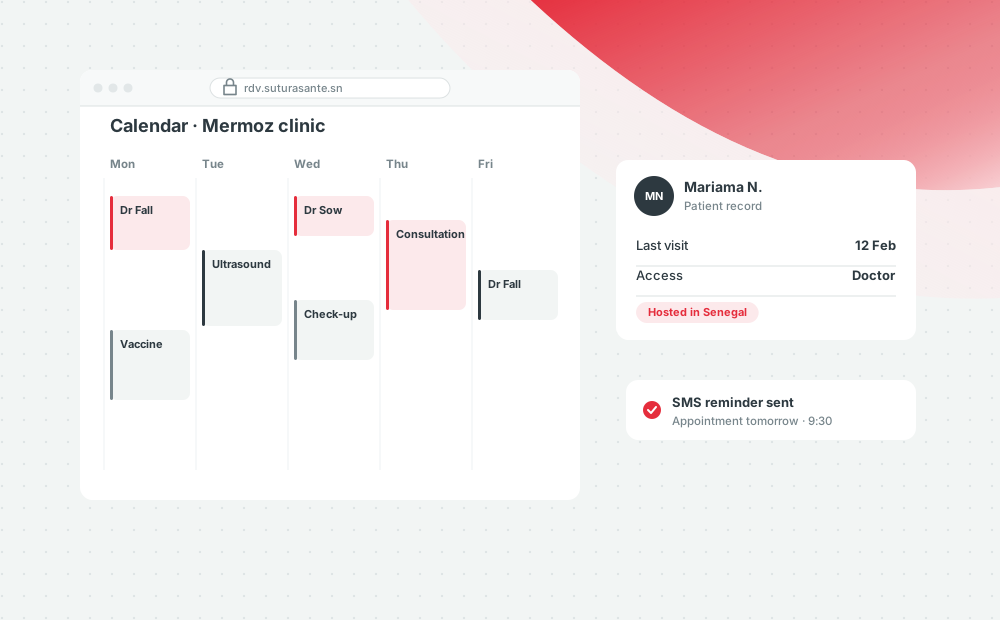
A platform hosted in a data center in Senegal, with a single patient record, a shared calendar and online booking. Identities are centralized with strong authentication, and backups are encrypted and tested every month.
- One patient record across all six clinics.
- Online booking and SMS reminders.
- Strong authentication and role-based permissions.
- Encrypted backups with monthly restore tests.
- Processing register and access log for the CDP.
How the project ran.
- 01
Assessment. Inventory of servers, data and flows, plus a privacy impact assessment.
- 02
Architecture. Hosting in Senegal, identity model and recovery plan.
- 03
Migration. One clinic at a time over weekends, with one week of parallel running.
- 04
Operations. Monitoring, restore tests and handover to the network’s IT team.
What changed.
Indicators tracked after launch.
99.9%
availability over the first six months
-60%
calls to reception thanks to online booking
4 h
to restore a full clinic, tested in real conditions
What made the difference
Compliance was treated as an architecture requirement from the assessment onwards, not as paperwork at the end.
Technologies
Kubernetes · Terraform · PostgreSQL · Keycloak · Backups chiffrés · SMS API